



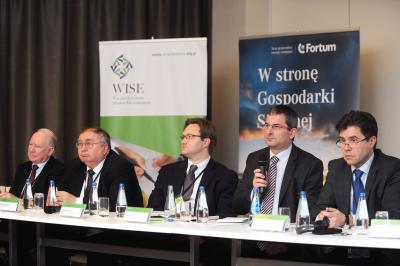
Goals of EU climate policy coincide with the direction of changes in the energy sector that must happen in Poland either way, policymakers must focus on creating domestic regulations that favor a sensible modernization of the energy sector – participants of “Energy and climate – do they go hand in hand?” conference said. The conference was organized by WISE institute and Fortum Power and Heat Polska.
Esa Hyvarinen, Senior Vice President at Fortum, emphasized that the new framework of climate and energy policy is more sensible than the previous one, as it focuses on emission reduction, allowing the member states to be flexible in developing renewable energy sources and improving energy efficiency. Professor Maciej Nowicki, the former Minister of the Environment, pointed out that renewable have a significant potential and that Poland will face problems if its high dependency on coal persists. Mirosław Duda (Energy Market Agency) sees nuclear energy development as a good way of curtailing future price increases caused by higher emission allowance prices.
Maciej Bukowski, WISE president, argued that energy prices have a very limited impact on the majority of Polish industry which has performed very well against the rest of Europe in recent years. He indicated that the troubles of Polish mining sector are often falsely associated with EU climate policy. In reality, this industry has fundamental problems with competitiveness. Paweł Smoleń, president of Euracoal stressed that renewables shouldn’t be contrasted with coal energy, since coal-fired power plants will have to complement intermittent renewable energy in the system.
During the interview summarizing the conference Marcin Korolec (the government’s plenipotentiary for climate policy) said that after the general framework for EU climate and energy policy was set, time has come for Poland to do its homework, i.e. work out national solutions allowing for an efficient modernization of Polish energy sector.
The conference organized by WISE Institute and Fortum Power and Heat Poland took place on November 28th at the Novotel in Warsaw. The first discussion panel, titled Energy and climate goals: in what direction is the EU climate and energy policy heading and what does this mean for Poland?, included: Mirosław Duda (advisor to the Board, Energy Market Agency), Esa Hyvarien (Senior Vice President, Corporate Relations, FORTUM), Adam Janczak (Deputy Director, Economic Department, Ministry of Foreign Affairs), Maciej Nowicki (expert, former Minister of the Environment) and the host, Jan Rączka (partner at Lynx Pattern).
The second discussion panel, titled Opportunities and dangers of low emission transformation, included: Maciej Bukowski (WISE), Tomasz Chmal (partner at White & Case), Krzysztof Karolczyk (Director of CHP Development, Fortum), Joanna Maćkowiak-Pandera (Senior Associate at Energiewende), Paweł Smoleń (President of Euracoal, partner at Deloitte Consulting) and the host, Grzegorz Siemiończyk (Rzeczpospolita).
The meeting was concluded by an interview with the Secretary of State and the Government’s Plenipotentiary for Climate Policy – Marcin Korolec.
Organized by:
Warsaw Institute for Economic Studies (WISE Institute) is a modern, independent think tank. We focus on strategic consultancy, economic and institutional analysis, as well as economic impact assessment of public policies. Scientiffic curiosity and professional analytical skills are combined with experience in both public and private sectors. Our main area of expertise include: the energy sector, climate policy, innovativeness, macroeconomics and political economy, development policies and labor markets. Our experts have more tha 10 years of experience in the industry.
Sponsored by:
FORTUM
Fortum is a Finnish energy giant – one of the largest electricity producers and distributors in the Nordic countries. It is also the fourth largest heat producer in the world. Outside of Finland, Sweden and Norway, the company invests in the Baltics, Poland and Russia. Fortum’s investment improve energy efficiency and reduce harmful emissions. Because of that, more than 86 percent of energy produced by the company in the EU was carbon free. At present, Fortum employs about 10 400 persons. In 2012 Fortum registered a turnover of 6.2 bn EUR and 1.7 bn EUR of operating profit. Fortum is listed on NASDAQ OMX stock exchange in Helsinki. In 2010 the company opened in Częstochowa the most modern combined heat and power plant of the region.


