

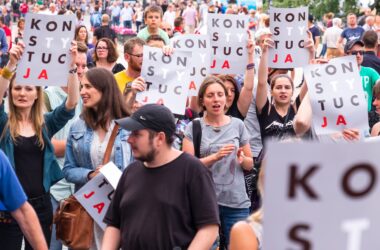
EU institutions are right in aggressively addressing the issue of illiberal reforms in some of the Member States.

The new judicial system in Poland is incompatible with the membership conditions of the European Union. That situation might be manageable in the immediate term, but it is not sustainable indefinitely.
Brexit confronts the EU with the challenge of losing its third largest Member State, one of its most vibrant economies, a substantial net contributor to the EU budget and also to the EU's defense
After Brexit, the V4 countries, often regarded as located on the sideline of European integration (excluding to a certain degree Slovakia, a eurozone member), may play a greater role in the EU.

Disputes over migration policy in recent years have skewed the picture of cooperation between the Visegrad Group countries and Germany.

Negotiations on the EU Multiannual Financial Framework (2021-2027) may lead to serious tensions between Poland, the European Commission, and Germany deriving from very different approaches to such fundamental issues as the rule of law or the Eurozone.

We have seen it several times before: a draft Multiannual Financial Framework which tries to find the middle ground between the widely diverging preferences of the main players.
Over the past decades, EU budget negotiations have been an issue of relatively little public attention in Germany. One might go so far and say that beyond the circles of the government,

"The Triangle of Weimar", designed as a communication and political platform, was meant to help shaping a new European order in a post-1989 era. It has its ups and downs.

We present the publication “German-Polish European Dialogue”, which summarizes the texts posted on the German-Polish European Blog, run by WiseEuropa since June 2017.


