


On Wednesday, 20 March, WiseEuropa along with the Centre for Eastern European Studies of the University of Warsaw, are organizing an open debate: "The emergence of new countries after the First World War: lessons for all of Europe." It is also the inauguration of the exhibition which will soon visit Lithuania, Latvia, Estonia, Finland and Brussels.

Selected publications on systemic approach to climate finance Publications by NewClimate Institute
Warning: Trying to access array offset on false in /home/serwer56/domains/wise-europa.eu/public_html/wp-content/themes/dfd-ronneby_child/templates/blog-fitRows-media.php on line 17
Warning: Trying to access array offset on false in /home/serwer56/domains/wise-europa.eu/public_html/wp-content/themes/dfd-ronneby_child/templates/blog-fitRows-media.php on line 20
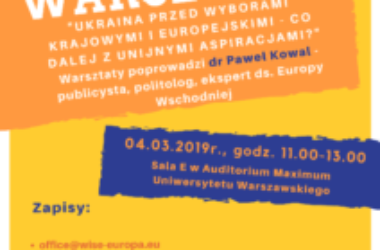
Take part in the workshop and present your ideas about the future of the European Union. We will collect them and we prepare the Manifesto which is presented to the newly elected members of the European Parliament. It’s one chance: 4th of March in the Centre for East European Studies.

On the 4th of March at 5 pm in the Ballroom of the Tyszkiewiczów-Potocki Palace (Krakowskie Przedmieście 32) will take place an open debate about the future of Europe. The debate will be attended by Paweł Kowal, PhD, Ludwika Włodek, PhD, Katarzyna Pełczyńska-Nałęcz, PhD, Marcin Kędzierski, PhD and Adam Balcer. The conversation will be led by the journalist, Agnieszka Lichnerowicz.

WiseEuropa, as part of the consortium, attended the SEnECA Midterm Conference and Scenario Workshop “EU and Central Asia Relations: Current Trends and Future Prospects” in Almaty, Kazakhstan (29th – 31st January 2019).

Is Poland ready to address the global trend such as sustainable finance? WiseEuropa’s experts, in the research paper “Sustainable finance in Poland.
The report "Immigrants in Poland in the context of a simplified procedure for employing foreigners" prepared by WiseEuropa, the University of Warsaw and the Center for Migration Research is now available for download.
The situation in the Western Balkans countries – Albania, Bosnia and Herzegovina, Kosovo, Macedonia, Montenegro and Serbia is becoming more and more challenging for the European Union.

Germany has made itself a reputation for being both an active supporter and a severe critic of the Western Balkans’ EU integration.


